Connecticut
STATE PROFILE
Statewide Updates as reported at 2017 NJDC Summit
New Haven
- School based arrests decreased 27% (60 to 44) from 2015-16 to 2016-17.
- The implementation of citywide restorative practices and revised code of conduct are showing a significant impact on school climate and discipline, with substantial decreases in out-of-school suspensions and expulsions.
- Out of School Suspensions decreased by 21% from 2015-16 to 2016-17 and have decreased by 27% since 2014-15.
- Expulsions decreased by 43% from 2015-16 to 2016-17 and have decreased by 57% since 2014-15.
- New Haven Public Schools has developed a plan moving forward to address truancy and chronic absenteeism in the 2017-18 school year after truancy matters will no longer be accepted by the juvenile court.
- The district’s chronic absenteeism rate decreased from 19.9% to 18.3% from 2015-16 to 2016-17.
- There was a substantial decrease in juvenile court delinquency referrals for the first quarter of the year.
- 21% decrease for the first 6 months of 2017 as compared to the first 6 months of 2016. This includes a 6% decrease for Black youth and a 52% decrease for Hispanic youth.
- There was a substantial decrease in secure detention admissions for the first 6 months of 2017 as compared to the first 6 months of 2016.
- 37% decrease for the first quarter of 2017 as compared to the first quarter of 2016. This includes a 27% decrease for Black youth and a 67% decrease for Hispanic youth.
Bridgeport
- Juvenile Court Delinquency referrals were down for the first 6 months of 2017
- Down 27% overall. Referrals for Black youth were down 23% and referrals for Hispanic youth were down 30%
- Secure Detention Admissions were down for the first 6 months of 2017
- Down 24% overall. Admissions for Black youth were down 22% and referrals for Hispanic youth were down 19%
- Misdemeanor referrals to court are down significantly through August 2017 (38% decrease)
Waterbury
- School based arrests decreased 19% from the 2015-16 school year and have decreased 32% since the 2014-15 school year.
- This includes a 7% decrease for Black students and a 22% decrease for Hispanic students
- Secure detention admissions for black youth decreased 13% for the first 6 months of 2017
Hartford
- School based arrests decreased by 51% from the 2015-16 to the 2016-17school year, with a 56% total decrease since the 2014-15 school year.
- These decreases involved a significant decrease in those lower level arrests for disorderly conduct or breach of peace charges
- Implementation of JRB protocols for both the police and schools directly refer youth to the JRB.
- Implementation of protocols based within schools to hone in specifically on reducing the number of youth charged with breach of peace and disorderly conduct
- Secure detention admission decreased by 38% when comparing the first 6 months of 2016 to the first 6 months of 2017, including a 45% drop for black youth.
- A protocol was implemented by the DCF regional office to ensure that the case of any child in congregate care who was arrested more than once within the year, would undergo an internal case review and also be referred to an educational consultant.
Recent Legislative Updates
PA 15-84 – AAC LENGTHY SENTENCES FOR CRIMES COMMITTED BY A CHILD OR YOUTH AND THE SENTENCING OF A CHILD OR YOUTH CONVICTED OF CERTAIN FELONY OFFENSES
- Response to US Supreme Court decisions in Miller and Graham. Provides a “second look” at juveniles that were convicted as adults for serious felony offenses committed while under the age of 18. Provides eligibility criteria and a process for juveniles to apply to the Board of Pardons and Parole (BOPP) for release on parole.
- Eligible to apply if the person was sentenced to 50 years or less and has served 60% of the sentence or twelve years, whichever is greater, or was sentenced to more than fifty years and has served 30 years.
- Provides a right to counsel for the parole hearing if indigent and sets forth specific criteria the BOPP must consider, including, but not limited to, the age and circumstances of the person when the crime(s) were committed, whether the person has demonstrated remorse and increased maturity since that time and such person’s efforts to overcome substance abuse, addiction, trauma, lack of education or obstacles such person may have faced as a child or youth in the adult correctional system.
- There is no right to appeal the BOPPs decision but the BOPP has the discretion to reassess a person for a new hearing after two years.
- Requires the court to consider the following factors at sentencing of a child who has been transferred to the adult docket for a class A or B felony conviction: Age at the time of offense, the hallmark features of adolescence, and any scientific and psychological evidence showing the differences between a child’s brain development and an adult’s brain development.
The bill’s full language can be found here.
PA 15-183 – AAC THE JUVENILE JUSTICE SYSTEM
- 14 y.o. children no longer eligible for transfer to the adult court for any offense.
- Class A felonies still subject to automatic transfer to adult docket but many class B felonies removed from the list of offenses automatically transferred and are now subject only to discretionary transfer after a hearing. Court must find, among other things, that the best interests of the child and the public will not be served by maintaining the case in the juvenile court and must consider any evidence that the child has intellectual disability or mental illness and the availability of services in the juvenile court that can serve the child’s needs.
- Judge in adult criminal court retains the discretion to return the case to the juvenile court at any time prior to a verdict or guilty plea for good cause shown.
- Precludes a pre-adjudicated detained juvenile from being restrained in court absent a court order.
The bill’s full language can be found here.
PA 16-147 – AAC RECOMMENDATIONS OF THE JUVENILE JUSTICE POLICY AND OVERSIGHT COMMITTEE
- Narrows the grounds for placing a child in detention. Eliminates the following grounds for detention: running away, the likelihood of committing other offenses; continued residence in the home poses a risk to the child; and violation of a suspended detention order. Child can only be detained now if: (A) probable cause exists that the child committed the delinquent act; (B) there’s no less restrictive alternative available; and (C)(1) probable cause exists that child poses a risk to public safety, (2) there’s a need to hold the child based on failure to respond to court process, or (3) there’s a need to hold the child for another jurisdiction.
- Requires the use of a detention risk assessment tool at the detention hearing in determining public safety risk.
- Reduces the length of time for detention hearing(s) from 15 days to 7 days or the dispositional hearing, whichever is shorter.
- Eliminates punishing the child as a goal in delinquency matters and adds the goal of providing “…individualized supervision, care, accountability and treatment to such child in a manner consistent with public safety.”
- Removes truancy removed from the list of Family with Service Needs (FWSN) offenses.
- Requires the State Dept of Education, DCF, DMHAS and CSSD to collaborate on school diversion initiatives for children with mental health needs in lieu of being placed into schools with high arrest rates and disproportionate minority contact.
- Requires DCF and the Judicial Department to implement an evidence-based recidivism reduction framework, for DCF to provided training in de-escalation techniques, track arrests within secure and residential facilities and for OPM to track and analyze the rates of recidivism for children.
The bill’s full language can be found here.
Juvenile Indigent Defense Delivery System
Connecticut has a statewide Division of Public Defender Services overseen by a bi-partisan commission. The Division employs a staff of permanent juvenile defenders throughout the state, and has a federally-funded Juvenile Post-Conviction & Re-Entry unit that represents adjudicated juvenile clients who have been committed to the Department of Children and Families. The Division contracts with private attorneys who serve as “Assigned Counsel” when the Division has a conflict of interest.
Determination of Indigence
The public defender is empowered to investigate claims of indigence. An indigent child is one who does not have the financial ability at the time of his request for representation to secure competent legal representation, or to pay other legal expenses. Conn. Gen. Stat. § 51-297(f).
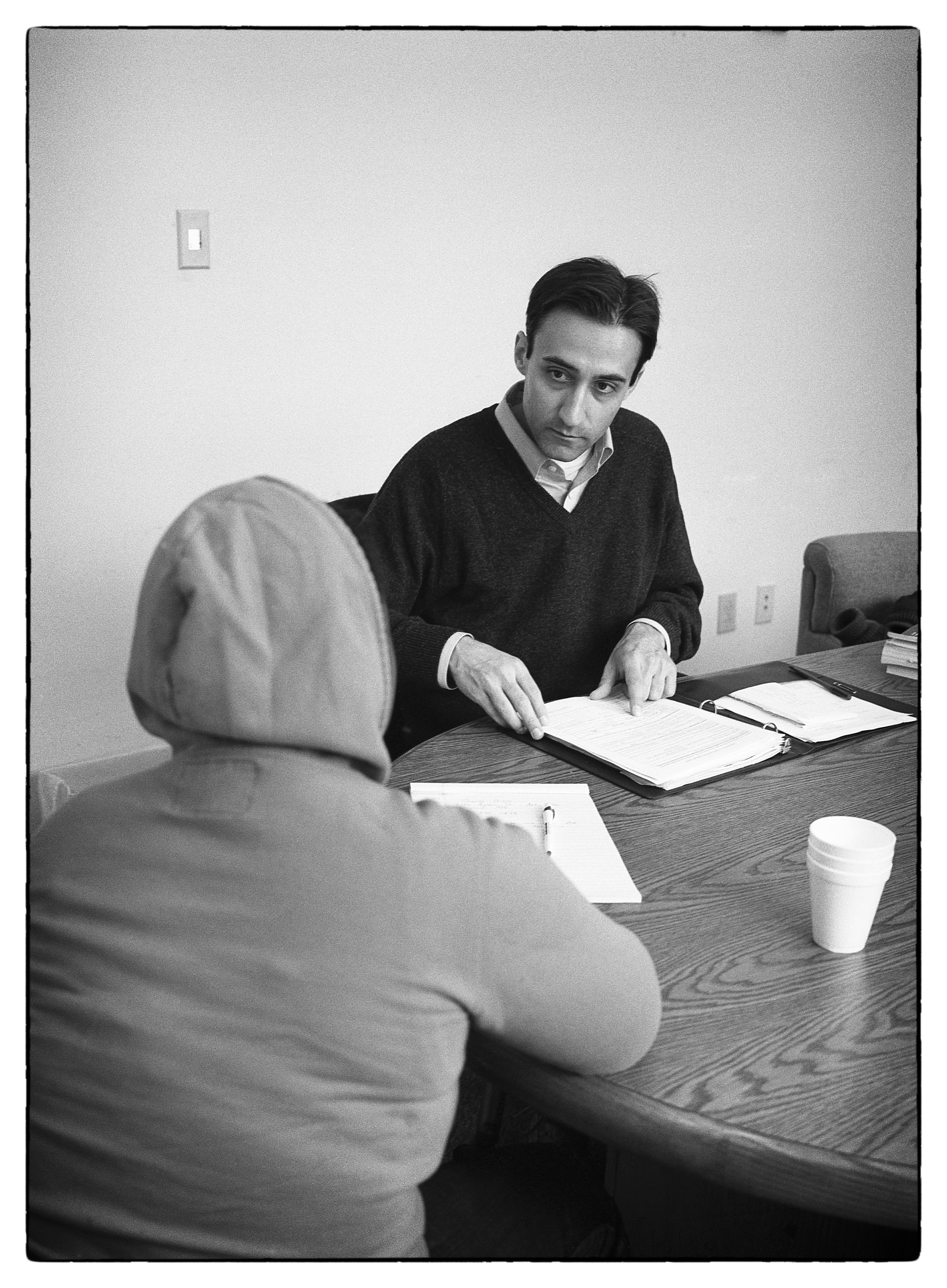
Student Attorney w/Juvenile Client
For any juvenile, the determination of ability to pay includes the financial resources of her parents or other guardian. Conn. Gen. Stat. § 51-299.
Ages of Juvenile Court Jurisdiction
- 7 has been established as the age of capacity in Connecticut. Conn. Gen. Stat. 46b-120(1)(A)(i)
- A person who commits a crime after attaining the age of 18 will no longer be under the jurisdiction of the Juvenile Court. Conn. Gen. Stat. § 46b-120.
- The Juvenile Court can retain jurisdiction of a juvenile who committed a delinquent act prior to his/her 18th birthday for the purpose of enforcing probation orders. Conn. Gen. Stat. § 46b-120.
Right to Counsel Provision
Conn. Gen. Stat. § 46b-136 allows a judge to appoint counsel for a child even in the absence of a request for counsel if the court “determines that the interests of justice so require.” There is no specific juvenile statute but juvenile case law interprets and utilizes the adult waiver of counsel statute: A waiver will be accepted only after the judicial authority makes a through inquiry and is satisfied that the defendant (1) has been clearly advised of the right to the assistance of counsel, including the right to the assignment of counsel when so entitled; (2) possesses the intelligence and capacity to appreciate the consequences of the decision to represent oneself; (3) comprehends the nature of the charges and the proceedings, the range of permissible punishments, and any additional facts essential to a broad understanding of the case; (4) has been made aware of the dangers of self representation. In re Manuel R., 543 A.2d 719 (Conn. 1988).
No conditions exist that prevent the juvenile from waiving their right to counsel.
Transfer to Adult Court
As of October 1, 2015, a child age 15 or older can be transferred to the adult court fot a felony charge. Automatic transfer occurs if the child is charged with a Class A or specified Class B felonies. P.A. 15-183. Children are presented in juvenile court, where age is established but no other argument is allowed. All other felonies may be transferred upon motion of the State’s Attorney and after a hearing where the state must prove that transfer is in the best interest of the child and the community. Conn. Gen. Stat. § 46b-127
Detention Statutes
- Code Section and Rules of Court: Conn. Gen. Stat. §§ 46b-133 to 46b-135.
- Detention Hearing: Business day next following arrest.
- Appointed Counsel at Detention Hearing: Almost always. Counsel is appointed at the Commencement of any proceeding. The court can assign paid counsel “in the interest of justice” even if a child’s family does not qualify for the public defender. Conn. Gen. Stat. § 46b-136.
Life Without Parole
- Connecticut has eliminated the sentence of mandatory life without parole for crimes committed when the offender was under the age of 18 P.A. 15-84
- Connecticut provides an opportunity for parole to all offenders sentence to more than 10 years for rimes committed before the age of 18. P.A. 15-84
- The minimum age for prosecution as an adult is 18
- The minimum age for sentencing a youth to life without parole is 18.
Important Connecticut Resources
Additional Resources
- Connecticut Juvenile Justice Alliance –Bridgeport, CT
- The alliance works to reduce the number of children and youth entering the juvenile and criminal justice systems, and advocates a safe, effective and fair system for those involved.
- Center for Children’s Advocacy — Hartford, CT
- Represents children in juvenile justice, child welfare, immigration and education cases and provides advocacy for legislative and policy changes impacting children.
- Juvenile Detention Centers — Bridgeport, CT and Hartford, CT
Visit Connecticut’s National Juvenile Justice Network Page